Project Overview
VetWatch is a private, secure web application designed to empower veterinary professionals by providing a safe and anonymous platform to review and share experiences about clinic workplaces. The project's core mission is to combat toxic work environments, burnout, and unethical practices by promoting transparency and allowing the community to warn and protect one another.
As the product visionary and lead designer, I conceptualized VetWatch to address a critical gap in the industry: the lack of a trusted space to discuss workplace culture without fear of reprisal. This case study documents the journey from a simple idea to a fully-featured, legally-safer, and moderated community platform.
My Role:
Product Vision, UX/UI Design, Project Direction
Tools Used:
Figma (for initial concepts), JavaScript, Firebase (Auth, Firestore, Hosting), Tailwind CSS, AIStudio/GeminiAI
The Problem: A Culture of Silence in the Veterinary World
The veterinary profession faces a mental health crisis, with rates of burnout, depression, and compassion fatigue among the highest of any medical field. A major contributing factor is the prevalence of toxic work environments—from poor management and understaffing to bullying and unethical pressures.
Professionals often feel trapped, unable to speak out for fear of damaging their careers or facing legal threats. Existing public review sites like Google or Glassdoor are inadequate as they are not tailored to the unique pressures of clinical practice and often mix client feedback with employee experiences, diluting the message.
The core problem was clear: How can we create a system that allows for honest, anonymous feedback about workplaces while protecting users from professional harm and the platform from legal risk?
The Solution: A Moderated, Anonymous, Clinic-Centric Platform
VetWatch was designed as a direct response to these challenges. It's not a public "shame board" but a private intelligence tool for a closed community. My design philosophy was built on three pillars:
- Safety First: The user's anonymity and legal safety are paramount. Every design decision prioritizes protecting the user and the integrity of the platform.
- Actionable Intelligence: The goal isn't just to vent; it's to provide valuable, at-a-glance information that helps professionals make better career choices.
- Simplicity and Focus: The user interface must be clean, intuitive, and mobile-first, allowing users to find or share information quickly without friction.
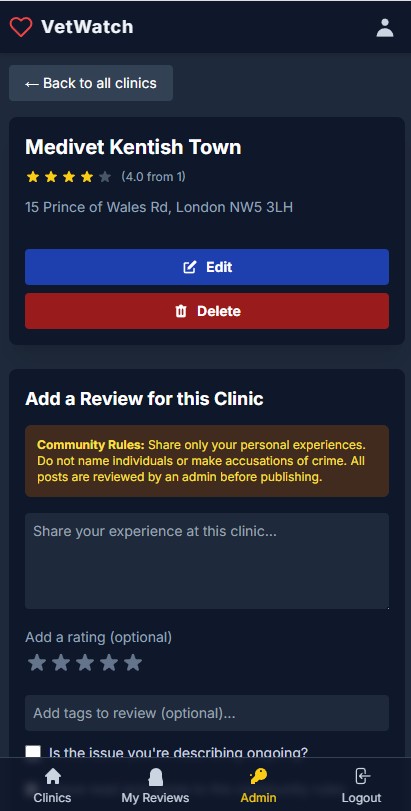
Admin mode UI of a Clinic page.
Key Features & The UX/UI Journey
1. The Access Gate: Fort Knox Security from the Start
Problem: The platform must remain private to prevent misuse by the general public or clinic management.
Solution: A simple, single-password "Access Gate" protects the entire application. Only individuals who are given the community password can even reach the registration page. This was the first line of defense, ensuring VetWatch remains a tool for the community, by the community.
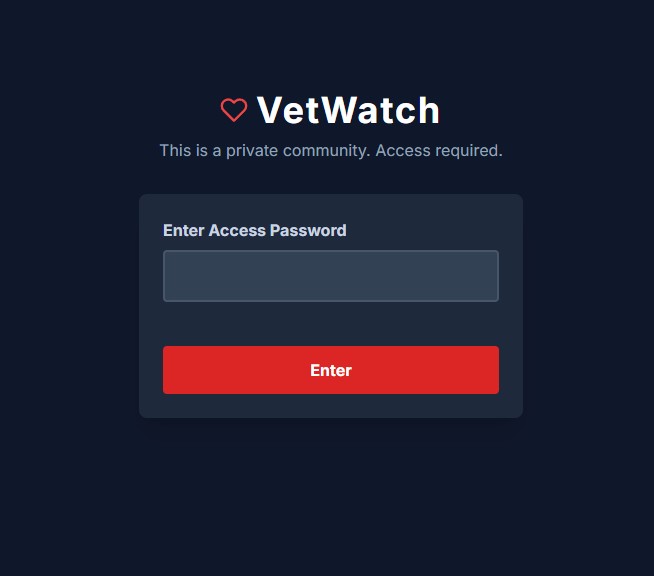
UI for the password gate, a single input field.
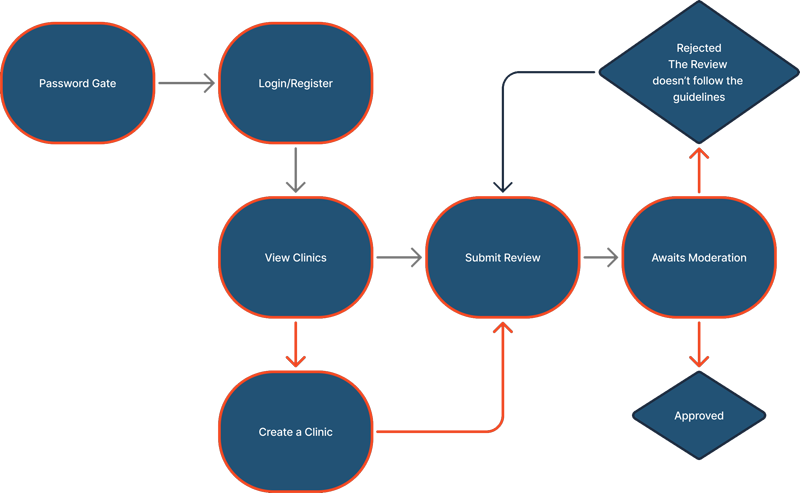
User flow diagram showing the seeker's and contributor's path.
The Information Seeker's Path:
- A new user first encounters the Password Gate, ensuring only invited members can proceed.
- They then Login or Register for an anonymous account.
- Once authenticated, they land on the main View Clinics directory, where they can browse and search for workplaces. From here, they can also choose to Create a Clinic if one is not already listed.
The Contributor's Path (The Moderation Loop):
- After viewing a clinic, a user can choose to Submit a Review.
- Crucially, every single submission enters the Awaits Moderation queue. This is a non-negotiable step that prevents harmful content from ever going public immediately.
- An administrator then reviews the submission. There are two possible outcomes:
- Approved: If the review follows community guidelines, it is approved and becomes publicly visible on the clinic's page.
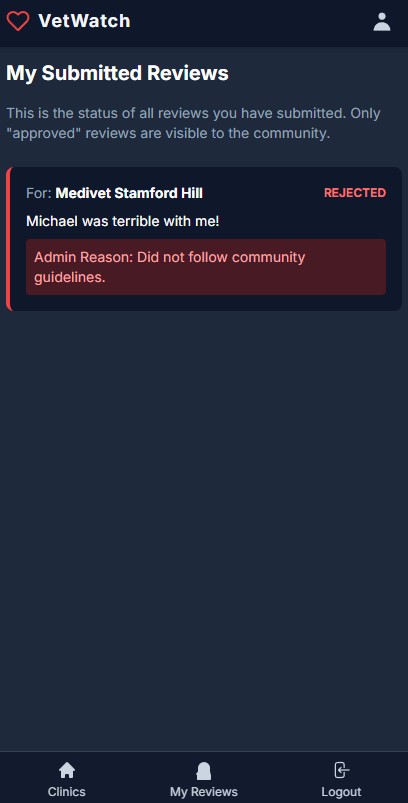
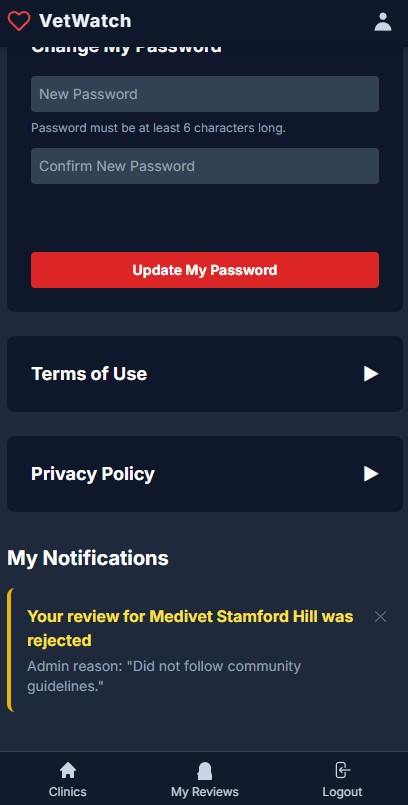
- Rejected: If the review violates the rules (e.g., names an individual), it is rejected. A notification with the reason is sent to the original poster, and the review is not published.
2. Anonymous & Secure Authentication
Problem: How to allow users to have a consistent identity for posting without collecting any personally identifiable information (PII) like emails.
Solution: We implemented a "Nickname + Password" system. Behind the scenes, we use Firebase's secure email/password authentication by programmatically assigning a dummy email (nickname@vetwatch.app), which the user never sees.
UX Win: Zero friction registration. Users feel safe knowing they aren't providing an email that could be traced back to them.
Technical Win: We leverage Firebase's robust, encrypted password handling without compromising user anonymity.
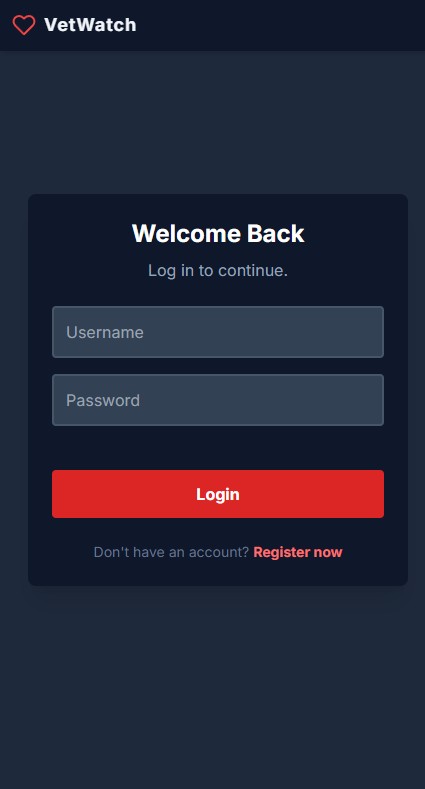
UI showing the simple nickname and password login/registration fields.
3. The Pivot: From People to Places
Initial Idea: Allow users to review specific, named individuals.
The Realization: After building an initial prototype, a critical legal and safety review revealed this was a major risk. Naming individuals, even in a private app, opens the door to defamation claims and targeted harassment.
The Strategic Pivot: We redesigned the entire application to be clinic-centric. Users review the clinic environment. This was the single most important decision to ensure the long-term viability and safety of the platform. Information about individuals is now conveyed through tags and context, not by name.
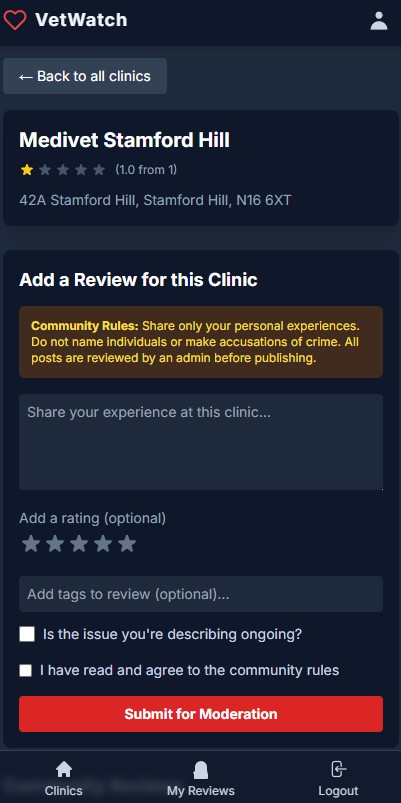
UI of a clinic's page, for posting a new review, adding tags, or reading reviews.
4. The Core Experience: Clinic Reviews & Moderation
Problem: How to allow honest negative feedback without creating a toxic or legally dangerous free-for-all.
Solution: A multi-layered moderation system.
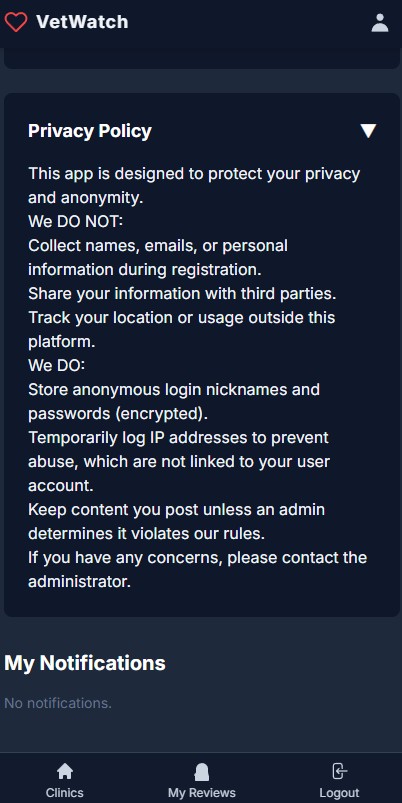
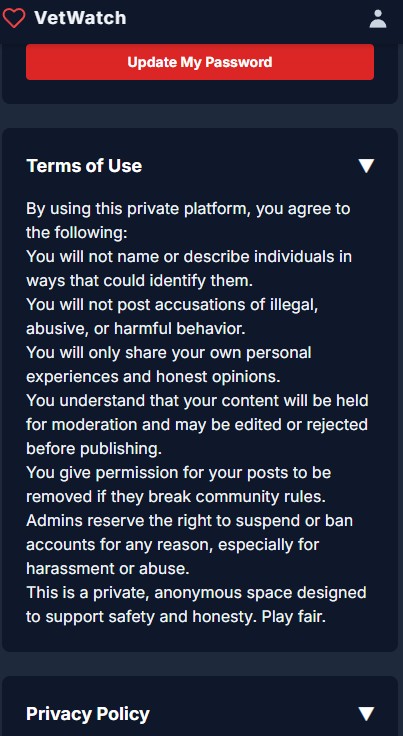
- Disclaimer & Rules: Before a user can type a review, they are presented with clear, simple community rules and must check an "I Agree" box. This sets expectations and establishes a legal basis for moderation.
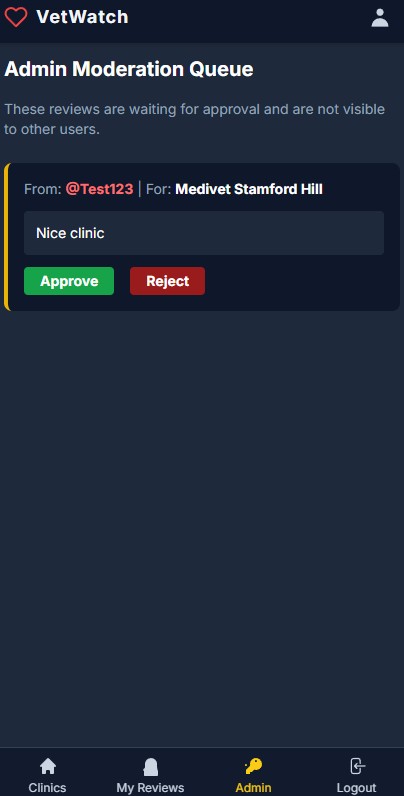
- Moderation Queue: Every single review is submitted to a "pending" queue. It is not visible to the public until an admin approves it. This is our core safety mechanism.
- Admin Panel: I designed a simple, powerful backend view for the "Sunshine" admin account. From here, an admin can see the original, uncensored text of a pending review and either Approve it, or Reject it with a clear reason that is sent as a notification to the user.
5. Data-Driven Insights: Ratings & Tags
Problem: Text reviews are detailed but hard to scan. Users need a quick way to assess a clinic.
Solution:
- Star Ratings: Users can optionally add a 1-5 star rating to their review.
- Aggregated Scores: The system automatically calculates the average rating for each clinic based on all approved reviews and displays it prominently on the home page and clinic detail page.
- Community-Sourced Tags: Instead of a predefined list, tags (#bullying, #great-team, #low-pay) are added by users directly on their reviews. The clinic page then aggregates and displays the most common tags, creating an organic, community-driven profile of the workplace culture.
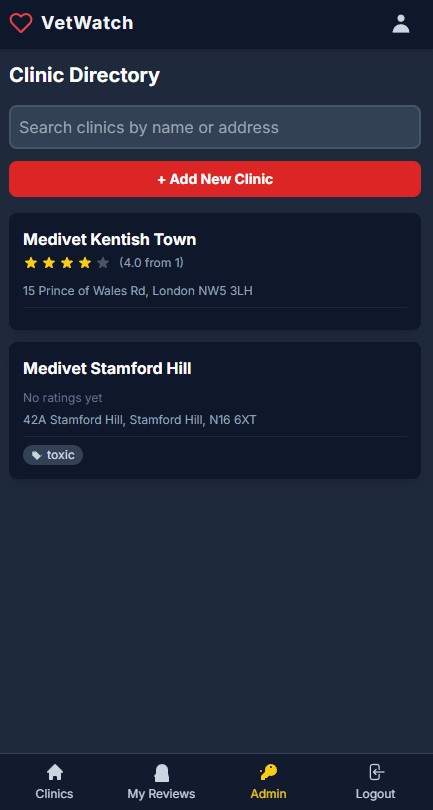
UI of the main clinic directory, showing clinics with their aggregated star ratings.
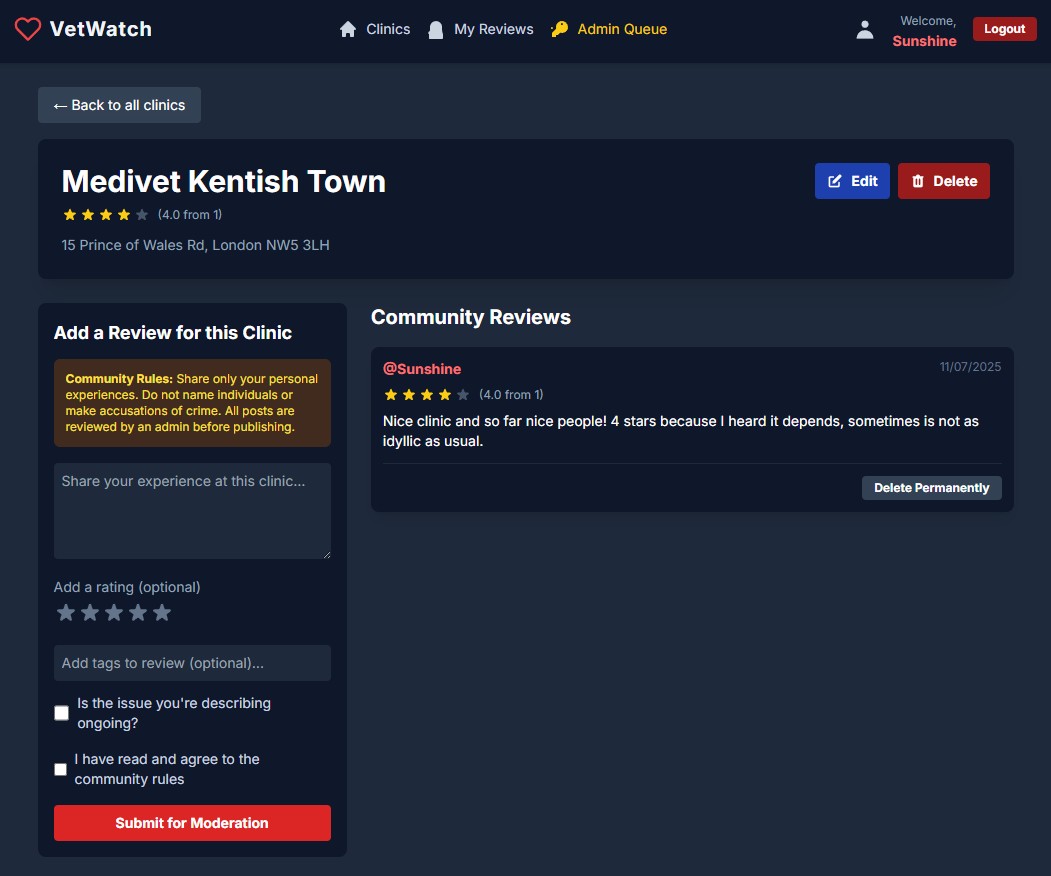
Admin mode UI of a Clinic page on desktop.
Final Outcome & Future Thoughts
Project Outcome: VetWatch successfully evolved from a high-risk concept into a sophisticated, secure, and legally-conscious platform. By prioritizing user safety and implementing a robust, admin-led moderation system, we created a tool that can genuinely help veterinary professionals navigate their careers and avoid toxic environments. The final product is a testament to an iterative design process, where we were not afraid to make major architectural pivots based on risk analysis and user-centric principles.
What I Learned
- The Primacy of Safety in Anonymous Systems: Building trust requires making safety visible at every step.
- Pivoting is a Strength: The decision to move from a person-centric to a clinic-centric model was difficult but ultimately saved the project from crippling legal risk.
- The Power of Moderation: A simple "pending/approved" queue is an incredibly powerful tool for maintaining community health without complex AI or external services.
Thank you for reviewing my project.